The Rise of Patient-Friendly Diagnostics: Redefining Cancer Screening in the Clinic and at Home
By: Eliza-Sara Casiean and Joe Abdo, PhD
Category: PSE
Read Time: 5 Minutes
By: Eliza-Sara Casiean and Joe Abdo, PhD
Category: PSE
Read Time: 5 Minutes
Last updated: 04 Dec 2025
Introduction: A Shift in Perspective
For decades, cancer screening has been a source of anxiety and discomfort. Procedures like colonoscopies, prostate biopsies, Pap smears, mammograms, and endoscopies often required patients to endure approaches that were invasive, time-consuming, and intimidating. That experience is now beginning to change. A new generation of minimally invasive and highly precise diagnostic tools is reshaping the landscape of cancer care. These advances offer simpler, faster, and far more patient-friendly options for early detection. Most importantly, these innovations empower people to take control of their health with greater confidence and clarity, while still improving outcomes.
Breast Cancer: From Compression to Comfort

Mammograms are a vital part of breast cancer prevention and are typically recommended every two years for women over 401. Yet for many, the procedure can bring discomfort and emotional stress. The compression of breast tissue during imaging can be painful, especially for women with dense tissue or past trauma. New technologies are changing that experience. Digital breast tomosynthesis, also known as 3D mammography, produces clearer and more detailed images while reducing false positives. Studies show that it improves detection rates by up to 51% compared to traditional 2D imaging and allows radiologists to tailor screening schedules to individual risk2. Researchers are also exploring whether a simple blood test could complement or even replace traditional mammography in the future. These liquid biopsy tests detect small fragments of tumor DNA circulating in the bloodstream, opening the possibility of early breast cancer detection without compression, radiation, or discomfort.
Colon Cancer: Innovations Offering a Helping Hand
Colon cancer remains the second leading cause of cancer-related deaths in the United States3. While colonoscopy is the long-established gold standard for screening, many people avoid it because of the unpleasant bowel prep, the need for sedation, or cost. Non-invasive options like the fecal immunochemical test (FIT) and the multi-target stool DNA test (Cologuard®) are improving accessibility4. These at-home tests can detect DNA mutations and methylation patterns linked to colorectal cancer, with no clinic visit, sedation, or prep required. Newer and more accurate tests that better identify pre-cancerous polyps may eventually offer even stronger protection, including Oxford BioDynamics’ upcoming EpiSwitch NST colorectal cancer and polyp detection blood test. Even so, Cologuard’s convenience and accuracy have already helped boost screening rates, especially in underserved communities. As a result, colonoscopy is increasingly used as a follow-up after an abnormal result rather than as the first step in screening.
Esophageal Cancer: A Simpler, Smarter Intervention
Traditional upper endoscopy is an effective diagnostic tool, but it requires sedation, fasting, and recovery, and it carries small but real risks of bleeding or perforation5. Lucid Diagnostics’ EsoCheck® offers a promising, patient-friendly alternative that is gaining traction. This swallowable balloon capsule collects esophageal cells in a quick, painless, and non-invasive way, allowing for early detection of Barrett’s esophagus and esophageal adenocarcinoma6. It is a clear example of how biomarker-driven innovation can make diagnostics faster, safer, and more scalable for patients who need it most.
Lung Cancer: From Detection to Prevention
Lung cancer is often discovered late because symptoms usually appear only after the disease has progressed. Low-dose CT (LDCT) scans have significantly improved survival by finding cancer earlier, but they still require specialized imaging and involve some radiation exposure7. Advances in artificial intelligence guided image analysis are aiming to strengthen this approach even further. Researchers are also developing blood-based and breath-based tests that detect circulating tumor DNA (ctDNA) and other molecular markers specific to lung cancer8. These minimally invasive methods could one day make lung screening as simple as a blood draw or breath sample, expanding access and reducing fear for millions of former smokers and high-risk patients.
Prostate Cancer: Beyond the uncertainty of PSA

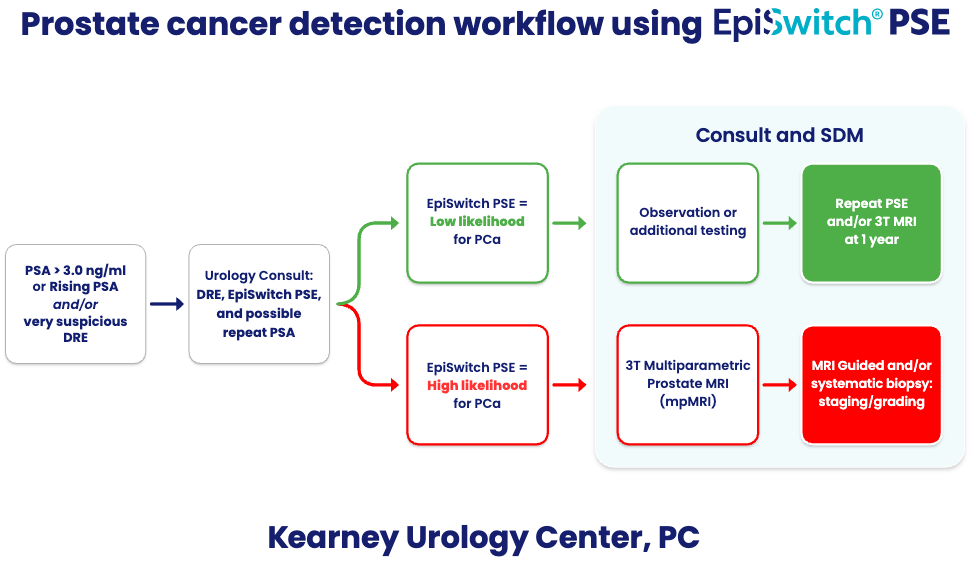
Although there is no standard population-wide prostate cancer screening program, the prostate-specific antigen (PSA) test has long been used in clinical practice as an early check for prostate cancer risk. PSA measures the level of a protein in the blood, but those levels can rise for many reasons that have nothing to do with cancer. This often leads to unnecessary biopsies, anxiety, and overtreatment. The routine EpiSwitch® PSE blood test offers a clearer path forward by analyzing epigenetic markers in immune cell DNA to assess risk with much greater precision. The test provides a simple binary result, “low likelihood” or “high likelihood” of prostate cancer, and delivers 97% specificity9.
Unlike a traditional biopsy, EpiSwitch PSE requires only a small blood sample that stays stable at room temperature for up to 30 days. It provides clarity and confidence for both patients and physicians, turning uncertainty into clear and actionable insight10.
Epigenetic Markers: The Next Frontier
At Oxford BioDynamics, the EpiSwitch platform sits at the forefront of this transformation. Instead of looking at DNA sequence alone, EpiSwitch Technology decodes the 3D genomic and epigenetic structure that organizes how genes are switched on and off in health and disease. The EpiSwitch PSE model shows what precision medicine can look like in practice. It delivers clear results, faster insights, and a lower burden on patients10. By combining advanced biology with everyday clinical practicality, it turns complex science into care that truly makes a difference.
Beyond Diagnosis: A New Hope for Cancer Care
In the past, early detection often came with pain, fear, and uncertainty. Today, patient-friendly diagnostics are transforming that experience and turning anxiety into empowerment. From at-home kits and AI-assisted imaging to advanced blood-based tests, innovation is making cancer detection clearer, faster, and more compassionate. For patients, this means confidence. For physicians, clarity. For healthcare as a whole, a higher and more humane standard of care.
About The Authors:
Eliza Casiean:
Eliza Casiean is an aspiring biomedical scientist from Linganore High School in Frederick, MD. As
a rising senior, she has already earned her PLTW Biomedical diploma from the Frederick County Career
& Technology Center, along with two additional Life Science certifications completed this past May.
Her work reflects a deep passion for medical research and a commitment to advancing patient-centered
innovation.
Joe Abdo, PhD:
Dr. Joe Abdo is a molecular oncology scientist with 18+ years of experience in translational research,
cancer diagnostics, and biotech innovation. He has authored 35+ peer-reviewed publications focused
on advancing early cancer detection strategies and strengthening real-world clinical utility. He
is a biomarker discoverer, inventor, and widely published researcher in oncology diagnostics, risk
stratification, and therapy optimization.
Proof Sources:
1) Reeves RA, Kaufman T. Mammography. In: StatPearls. Treasure Island (FL): StatPearls Publishing; July 24, 2023.
2) Bernardi D, Macaskill P, Pellegrini M, et al. Breast cancer screening with tomosynthesis (3D mammography) with acquired or synthetic 2D mammography compared with 2D mammography alone (STORM-2): a population-based prospective study. Lancet Oncol. 2016;17(8):1105-1113.
3) Kastenberg D, Bertiger G, Brogadir S. Bowel preparation quality scales for colonoscopy. World J Gastroenterol. 2018;24(26):2833-2843. doi:10.3748/wjg.v24.i26.2833
4) Clebak KT, Nickolich S, Mendez-Miller M. Multitarget Stool DNA Testing (Cologuard) for Colorectal Cancer Screening. Am Fam Physician. 2022;105(2):198-200.
5) Levy I, Gralnek IM. Complications of diagnostic colonoscopy, upper endoscopy, and enteroscopy. Best Pract Res Clin Gastroenterol. 2016;30(5):705-718.
6) Moinova HR, Verma S, Dumot J, et al. Multicenter, Prospective Trial of Nonendoscopic Biomarker-Driven Detection of Barrett's Esophagus and Esophageal Adenocarcinoma. Am J Gastroenterol. 2024;119(11):2206-2214. doi:10.14309/ajg.0000000000002850
7) Hoffman RM, Atallah RP, Struble RD, Badgett RG. Lung Cancer Screening with Low-Dose CT: a Meta-Analysis. J Gen Intern Med. 2020 Oct;35(10):3015-3025.
8) Park JA, Suzuki K. Novel Screening Tools for Lung Cancer. Thorac Surg Clin. 2023;33(3):215-226.
9) Pchejetski D, Hunter E, Dezfouli M, Salter M, Powell R, Green J, Naithani T, Koutsothanasi C, Alshaker H, Jaipuria J, et al. Circulating Chromosome Conformation Signatures Significantly Enhance PSA Positive Predicting Value and Overall Accuracy for Prostate Cancer Detection. Cancers. 2023; 15(3):82
10) Berghausen J, Abdo J, Mathis R, Hunter E, Akoulitchev A, Pohlman GD. EpiSwitch PSE Blood Test Reduces Unnecessary Prostate Biopsies: A Real-World Clinical Utility Study. Cancers. 2025; 17(13):2193. https://doi.org/10.3390/cancers17132193
Subscribe to receive our latest blog posts
Topics from groundbreaking discoveries to cutting-edge advancements and industry
trends.
The EpiSwitch PSE test is a powerful diagnostic tool that determines a person's current likelihood of having prostate cancer. Used alongside or after a standard PSA test, PSE significantly improves detection accuracy and helps reduce unnecessary MRIs, biopsies, and treatments.
This powerful test is valuable for identifying individuals requiring biopsy and those suitable for active surveillance without further testing.
Learn About PSE